

How to Get Cited in AI Search
To get cited in AI search, your content must be clear, structured, authoritative, and easy for AI systems to extract and reuse as a direct answer. Search hasn’t just evolved, it has been redefined. Platforms like ChatGPT, Google AI Overviews, and Perplexity AI now generate answers directly instead of sending users to websites.
Users ask a question, read the answer, and often leave without clicking. That answer is built from sources. And if your content isn’t one of them, you’re not just losing traffic, you’re missing the moment where trust is formed and decisions begin.
The Real Shift: From Ranking to Being the Answer
For years, SEO was about ranking higher. That worked when search engines acted as a bridge between users and websites. But AI has changed that role. Now, the answer often appears before the click. The user no longer needs to explore multiple pages. They receive a summarized response that already combines several sources. That means visibility has moved. It no longer lives on your page. It lives inside the answer itself. You can rank #1 and still be ignored. And you can be cited without ranking at the top.
What the Data Actually Shows
The shift isn’t theoretical; it’s measurable. AI systems are not prioritizing the most visible content, they are prioritizing the most usable and trustworthy content.
AI Assistants vs Traditional Search (SERPs)
Across major AI assistants, the overlap with Google rankings is surprisingly low.
- On average, only about 12% of AI citations appear in Google’s top 10 results
- For Bing, the overlap is even lower at around 10%
- Perplexity AI comes closest to traditional search behavior, with 28.6% of its cited pages ranking in the top 10
- For tools like ChatGPT, Gemini, and Copilot, the overlap is much lower, and in many cases, more than 80% of cited pages do not rank at all for the original query
This means that most content cited by AI is coming from pages that traditional SEO would not normally prioritize.
Inside Google AI Overviews (Evolving Fast)
Within Google’s own AI results, the pattern is different, and changing quickly.
- Earlier studies showed that about 76% of AI Overview citations came from top-10 ranking pages
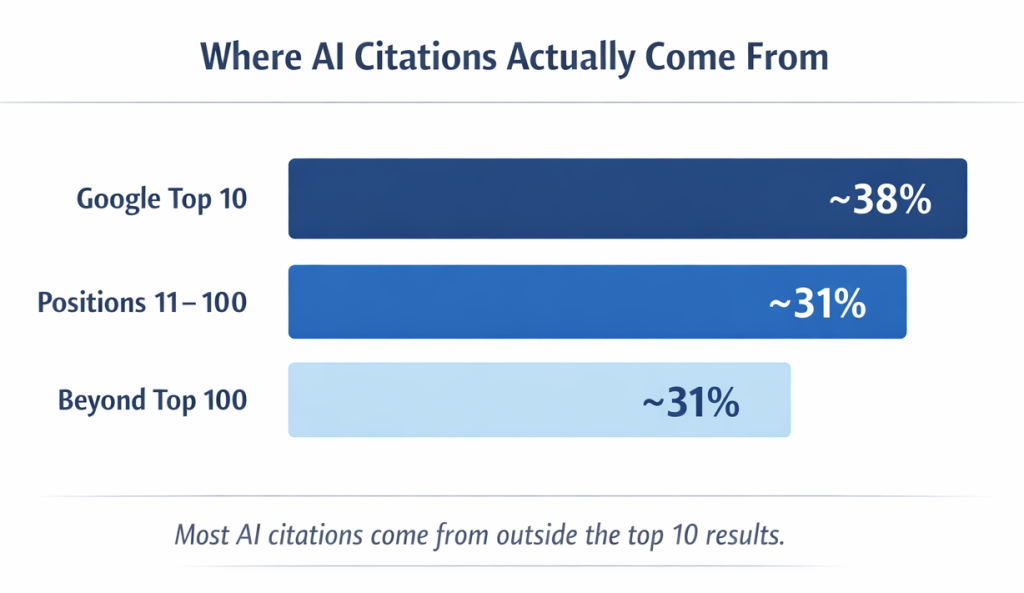
- More recent data shows this has dropped to around 38%, indicating a clear shift
Where citations now come from:
- Around 31% come from pages ranking between positions 11 and 100
- Another 31% come from pages beyond the top 100
At the same time, AI Overviews are becoming more common:
- They now appear on roughly 48% of queries
- This is an increase of about 58% year over year, meaning more users are seeing AI-generated answers instead of traditional results
This shows that AI visibility is expanding, while reliance on top rankings is decreasing. AI is no longer simply reflecting search rankings, it is selecting sources based on different signals.
What Gets Cited (Content-Type Signal)
There is also a strong pattern in the type of content that gets cited.
According to analysis covered by Search Engine Journal:
- News publishers account for about 14% of all AI citations
- Within that group: About 81% of citations come from original editorial content, And only about 0.9% come from syndicated news content
- Syndicated press releases contribute just 0.04% of the total dataset, making them almost negligible
This indicates that AI systems strongly favor original reporting and analysis over reused or distributed content.
What This Means in Practice
AI does not simply reward content that ranks or exists online.
It tends to favor content that is clear, original, and useful enough to be reused as part of an answer.
AI tends to prefer:
- original editorial content created with intent and depth
- explanations that provide context, not just definitions
- content that adds unique insights or perspective
AI tends to ignore:
- syndicated press releases and distribution-based content
- duplicated or republished material
- surface-level summaries that do not add new value
How Users Actually Experience AI Search
The user journey has changed more than most analytics dashboards reflect. A user asks a question. An answer appears instantly. They read it, scan a few sources, and move on. Sometimes they click. Often they don’t. But something important still happens. They form an impression. They start recognizing names. They associate certain brands with certain topics. They build trust before ever visiting a site. That means visibility now comes before traffic. And in many cases, traffic only follows if that trust is already established.
What AI Citations Actually Are
AI systems don’t create knowledge, they assemble it. They scan content, extract relevant parts, and combine them into a single response.
That creates two types of visibility:
- Citations → your content is used and linked
- Mentions → your brand appears without a link
Both matter, but citations are where visibility and traffic intersect.
The key difference is simple:
You’re not competing for clicks.
You’re competing to become part of the answer.
How AI Actually Chooses Sources
AI doesn’t rank pages the way search engines do. It retrieves and assembles information from multiple angles. Instead of matching one query, it expands into variations and looks for content that consistently answers those variations well. This is why many cited pages don’t rank for the exact keyword. From there, a few patterns are consistent.
Content that gets cited is:
- clear and direct
- easy to extract
- well structured
- supported by broader authority
Clarity matters because AI needs reusable sentences. Structure matters because it makes sections standalone. Authority matters because AI prefers sources it can trust. And originality matters because AI does not need another version of what already exists.
Google AI Is Not One System
One of the biggest mistakes is treating “Google AI” as a single system. It isn’t.
Different surfaces behave differently:
- Social content makes up about ~3% of Gemini citations
- Around ~9% in AI Mode
- And about ~13% in AI Overviews
Even within those:
- Reddit drives around ~44% of AI Overviews’ social citations
- But only about ~5% in Gemini
- Medium contributes roughly ~28% of Gemini’s social citations
AI Mode also cites ~143% more unique domains than AI Overviews.
This means: There is no single strategy for Google AI. You’re dealing with multiple systems, each with its own logic.
The AI Citation Ecosystem
AI does not rely only on your website. It pulls from a wider ecosystem that includes:
- blogs
- forums like Reddit
- video platforms like YouTube
- editorial sites
- review platforms
This changes how visibility works. You’re no longer just optimizing pages.
You’re building presence across the web.
What Actually Increases Your Chances of Being Cited
Across research and real-world patterns, the same things keep showing up.
Content that gets cited:
- answers questions immediately
- is structured clearly
- demonstrates multi-channel authority beyond the page
- includes something original that others can’t replicate
Generic content doesn’t get selected. Not because it’s wrong, but because it’s replaceable.
From Insight to Execution: What You Should Do Next
Understanding the shift is one thing. Acting on it is another. Here’s how to apply this immediately.
Start by fixing one page, not your entire site. Add a clear answer at the top, rewrite a few sections so they stand alone, and make the structure easier to extract.
Then adjust your headings. Turn them into real questions and ensure each section answers that question directly.
Next, add something original. This is critical. Include an insight from your own experience, a pattern you’ve observed, or a real example. Even a small section like “what we’ve seen in practice” can make a difference.
At the same time, expand your presence. Share your ideas on LinkedIn, contribute to discussions on Reddit, and repurpose your content into other formats.
Finally, test your content like an AI would. Ask yourself: is the answer clear in the first few lines? Can this section be reused on its own? Does it add anything new? If not, improve it.
Align Your Content With the Audience Journey
AI systems don’t just evaluate pages, they reflect how people discover, learn, and decide across multiple touchpoints. If you want to be cited consistently, your content needs to align with the entire audience journey, not just the moment someone searches.
Awareness Stage: Become Discoverable Before Search
At this stage, people aren’t searching yet, they’re discovering. This is where social platforms, PR, and podcasts matter. Sharing unique data, trends, or insights helps you get noticed and referenced early, especially by journalists and industry platforms.
Consideration Stage: Become the Source People (and AI) Learn From
At this stage, users turn to search engines. This is where your SEO content matters most. Detailed guides, how-to content, and comparisons help both users and AI systems understand and reuse your content as a reliable source.
Decision Stage: Reinforce Trust and Drive Action
When users are ready to act, they don’t need more information, they need confidence. Content here should focus on validating decisions. Case studies, testimonials, and real-world examples help reduce uncertainty. PR and customer stories can further strengthen credibility by showing how real people are solving problems or achieving outcomes.
Add What AI Can’t Replicate (This Is Where You Win)
This is the most important part. AI is very good at summarizing existing information. If your content only does that, it is easily replaceable. To stand out, you need to add something AI cannot easily generate.
That includes:
- first-hand experience
- original data or observations
- unique frameworks
- strong, clear opinions
- real examples
Even one of these can change how your content is perceived. For example, instead of repeating general advice, explain what you’ve actually seen working, what failed, or what most people misunderstand. That’s what makes your content valuable.
Guide Readers to High-Trust References
AI systems also evaluate what your content connects to.
Linking to credible, relevant sources strengthens both trust and context.
Instead of adding random links, guide readers toward:
- industry research
- data-backed studies
- expert analysis
- authoritative resources
AI SEO vs Traditional SEO
Traditional SEO | AI Search Optimization |
Rank for keywords | Be selected as a source |
Focus on clicks | Focus on trust & visibility |
Optimize pages | Optimize answers |
Backlinks dominate | Authority + mentions + context |
Final Thoughts
SEO isn’t disappearing. But it is becoming more selective. The system is no longer rewarding content that simply ranks. It rewards content that can be understood, trusted, and reused. That raises the bar. But it also makes the path clearer. You’re not trying to win a position. You’re trying to earn a place in the answer.
“The future of search belongs to content that is clear enough to extract, strong enough to trust, and valuable enough to cite.”